
If you're building a custom home in Lakeview, you've already picked the community, so this post isn't a sales pitch for Lakeview. It's a field guide form builder who's worked this neighbourhood: what we look at first when we walk a lot, the budget surprises that come out of a 1960s bungalow teardown, the reservoir-side soil issues that catch out-of-area builders and the August 4 2026 zoning deadline that matters for anyone permitting this year. Our goal is simple, you should know the things we'd flag on a site walk before you sign anything.

What we look at first when we walk a Lakeview lot
Lakeview was built out in the early-to-mid 1960s. That means almost every lot you'll look at has a 55-to-65-year-old original bungalow or split-level on it, and the lot itself carries some things the MLS listing won't tell you. On a first walk, we're checking:
- Original service entrance. Most 1960s Lakeview homes were built with a 60-amp service. You need 200 amps for a modern custom home with induction cooking, EV charging, AC, HRV, and in-floor heat. That's a mandatory service upgrade — factor it in.
- Water service line size. 3/4-inch copper was standard in 1960s Lakeview. A 3,000+ square foot custom home with two ensuites wants a 1-inch service. That's a curb-stop-to-house replacement, and the permit and City coordination adds three to five weeks.
- Sewer stack and main. Original Lakeview sewer mains are a mix of clay tile and cast iron. Clay tile develops root intrusion. We camera-scope the line on every Lakeview teardown before we commit to a foundation plan.
- Lot slope. Lakeview generally slopes toward the Glenmore Reservoir on the south side. On lots south of 60 Avenue, the drop can be meaningful. That shapes whether a walkout basement makes sense and where the garage wants to sit.
- Trees. The tree canopy in Lakeview is 60 years old. Large spruces and poplars over 30 cm DBH are a real protection constraint — and usually also the reason someone fell in love with the street. Plan around the mature ones, not through them.
The 1960s bungalow surprises that move a Lakeview budget
Every teardown has unknowns. Lakeview's 1960s bungalow stock has a specific list of them. These are the items we've hit on our last five Lakeview builds, and they're what we budget a contingency against:
- Asbestos. Popcorn ceilings, vermiculite attic insulation, 9-inch floor tiles, pipe insulation on the original boiler mains, and some drywall compounds all commonly contain asbestos in a 1960s Lakeview home. Abatement adds $8,000 to $25,000 depending on what's found. We spec an abatement survey before demolition, every time.
- Aluminum wiring. Not as common as in 1970s builds, but present on some later-1960s Lakeview homes. If it's there, it has to come out — it's a code issue, not a preference.
- Cast iron drain stacks. Original in most of Lakeview. They go in the demolition pass.
- Gas line sizing. Originals were sized for a furnace, a water heater, and a range. A modern custom home with a gas fireplace, a gas range, a dryer, BBQ rough-in, and a high-efficiency furnace often needs a larger line from the meter.
- Undersized basement height. Many original Lakeview basements are 6-foot-6 or 6-foot-8 clear. On a rebuild, you're digging deeper — and the dig needs geotechnical work before you commit.
We budget $50,000 to $80,000 as a site-specific contingency on Lakeview teardowns to absorb these. On a fixed-price contract, that contingency is defined and sits with the builder. On a cost-plus, it becomes your problem in month three. We've written about that tradeoff on our fixed price custom homes page.
Lakeview lot sizes and what they actually build on
Lakeview's original plat is generous by inner-city Calgary standards. Typical lots:
- Standard interior lot: 58 feet wide by 100 feet deep (5,800 sq ft) — the most common parcel
- Wider interior lots on certain blocks: 60 to 65 feet wide, 110 to 120 feet deep
- Corner lots: often 65 to 75 feet wide
- Larger premium lots on streets backing greenspace or the reservoir pathway: 10,000 to 17,000 sq ft (some of Lakeview's largest lots)
On a 58x100 lot, we comfortably design a 2,800 to 3,400 square foot home above grade, a developed basement, and a rear-attached or rear-detached double garage. The shallower 100-foot depth (versus Altadore's 120-foot standard) affects backyard programming — plunge pools, outdoor rooms, and detached garage placement all want design time, not a default.
Lot pricing in Lakeview has moved in the last three years. 2026 market data shows the Lakeview average listing price sitting around $1.46 million — roughly 2x the Calgary average. For a bought-and-scraped standard Lakeview lot, plan:
- Standard 58x100 scrape: $900,000 – $1.3 million
- Wider interior / corner lot: $1.3 – $1.7 million
- Premium reservoir-adjacent or oversized lot: $1.8 – $2.5 million+
Soil, slope, and the Glenmore Reservoir water table
This is the part of a Lakeview build that out-of-area builders miss. Lakeview sits on the north shore of the Glenmore Reservoir, with Weaselhead Flats to the west and the Elbow River drainage nearby. That matters for three reasons:
- Water table varies block by block. Lots closer to the reservoir and the Weaselhead tend to hit groundwater earlier on the dig. We've found seasonal water within 8 to 12 feet of grade on some south-Lakeview lots. That changes foundation design, waterproofing spec, and whether a walkout is realistic.
- Geotechnical report is not optional. For any Lakeview build where you're taking a basement below original depth or adding a walkout, a geotech report isn't a "nice to have" — it's what keeps your foundation from becoming a warranty claim. We spec one up front on every Lakeview job.
- Exterior waterproofing spec. On Lakeview basements, we default to a full dimple-board membrane, upgraded weeping tile, sump with backup, and an interior perimeter drain. That's above code minimum, and it's what a 30-year house needs this close to the reservoir.
We dig into this specifically for the adjacent community on our building in North Glenmore post, where the water table issue is similar. A lot of the same principles apply North of 66 Avenue in Lakeview.
The R-CG Repeal and your Lakeview lot
If you're permitting in 2026, this is the calendar item. Calgary Council approved the repeal of the May 2024 blanket R-CG rezoning after the March 23, 2026 public hearing. The repeal takes effect August 4, 2026. Applications filed before that date are processed under today's R-CG rules; applications filed after revert to each lot's pre-2024 district — for most of Lakeview, that's R-C1.
For a single detached custom home on a 58-foot Lakeview lot, R-C1 versus R-CG mostly doesn't change the house you can build. Where it matters:
- Laneway and secondary suites. R-CG is more permissive. If a laneway suite above the detached garage is part of your plan, filing before August 4 is meaningful.
- Future resale optionality. A lot that stays R-CG has more redevelopment ceiling for a future owner. Some Lakeview buyers are pulling permit timelines forward specifically to lock this in.
- Duplex or side-by-side plays. Rare in Lakeview, but possible on wider corner lots under R-CG. Those plays disappear after August 4.
If your plans include a laneway suite, a 4-unit ceiling for resale optionality, or any departure from straight single-detached, we want your Development Permit or Building Permit application in the system by mid-July 2026 at the latest.
schools that buyers want on the lot they're building
Lakeview's school quality is a lot-pricing factor — buyers pay a premium to be in the in-community catchment, and it shapes resale. The CBE catchment for Lakeview:
- Jennie Elliott School (CBE, K-6) — in Lakeview, on 66 Avenue SW. The community anchor elementary.
- Bishop Pinkham School (CBE, 7-9) — in Lakeview, offering both English and French programs. Walkable from most of the community.
- Central Memorial High School (CBE, 10-12) — in adjacent North Glenmore Park, just east of 37 Street SW.
Private and charter options within a short drive include Connect Charter School, Rundle College, and Calgary French & International School.
If school proximity is part of the brief, lot selection on streets within a 5-minute walk of Jennie Elliott or Bishop Pinkham holds value differently than lots on the Glenmore Trail edge. We flag this at the lot-screening stage.
Always verify current catchment on the CBE Find a School tool — boundaries can shift.
DESIGNING for lakeview's 1960s streetscape without getting dp-slapped
Lakeview doesn't have a formal Area Redevelopment Plan the way Mount Royal or Britannia do. But the streetscape is predominantly 1-storey bungalows and 1.5-storey split-levels. A 2.5-storey box on a Lakeview block reads loud, and Development Permit feedback reflects that. Things we design around:
- Front massing. Recessed second storeys, broken rooflines, and real front-entry detail scale a custom home down from the street even when the gross floor area is large.
- Roof pitch. 1960s Lakeview is hip roofs and shallow gables. A steep modern gable reads foreign unless it's balanced against a quieter secondary mass.
- Garage orientation. Most Lakeview blocks don't have rear alleys. Front-facing garages are the norm — and they need to be subordinate to the entry, not the other way around.
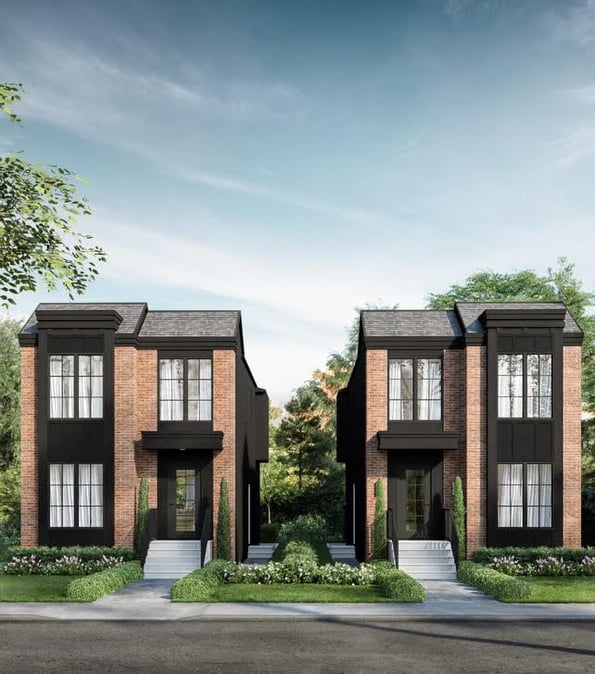
- Material palette. Brick, stone, stucco, wood-look siding — Lakeview reads traditional. Full-black, full-cedar, or mirror-glass façades clash. Mixed palettes land better.
This isn't about building a bungalow. It's about a 3,200 square foot custom home that doesn't pick a fight with the street it's sitting on.
how long a lakeview custom build actually takes
From signed lot purchase to move-in, plan 14 to 18 months:
- 2 to 3 months: Design development, structural and mechanical engineering, geotech, permit application
- 6 to 10 weeks: Building Permit (a Development Permit adds 8 to 14 weeks if triggered — corner lots, setback variances, or laneway suites commonly trigger one)
- 1 to 2 weeks: Demolition and site prep, including abatement if needed
- 10 to 13 months: Construction
Geotech turnaround and abatement add real days on Lakeview specifically — factor a couple of weeks into the pre-construction phase that you wouldn't need on a newer community.
common mistakes on a lakeview custom build
- Skipping the geotechnical report to save a few thousand dollars. On a lot this close to the reservoir, you're buying a 30-year foundation problem for a three-week budget saving.
- Budgeting no abatement contingency. Asbestos in a 1960s Lakeview home isn't a maybe. It's a when-and-how-much.
- Designing the house before the lot. Lakeview's slope, tree canopy, and setback quirks vary block to block. House-first, lot-second designs end up getting remixed at permit stage.
- Missing the August 4, 2026 R-CG window when the plan includes a laneway suite or future resale optionality.
- Fighting the streetscape. A design that loudly dominates a 1-storey bungalow block invites DP friction and dents resale. Sympathetic massing holds value better.
faqs about building a custom home in lakeview
Thinking about a lakeview build?
If you're already settled on Lakeview and want a builder who knows what the lot will give you before you close on it, that's the conversation our pre-construction agreement is built for. We walk the lot, run preliminary soils, scope the teardown realistically, and get real numbers on paper before any shovels move. Reach out and we'll set up a first call.



Leave a Reply
Your email address will not be published.